Chamberlain Junior High School
Stephen King Three Classic Novels Box Set: Carrie, 'Salem's Lot, the ShiningChamberlain Junior High School is significant less as a fully described physical setting than as an early institutional marker in the social history of Carrie White’s persecution. It is where the culture of ridicule attached to Carrie and where Christine Hargensen’s record already displayed the pattern of cruelty, privilege, and evaded consequences that would continue into Ewen High School.
Early Stigma and Schoolyard Cruelty
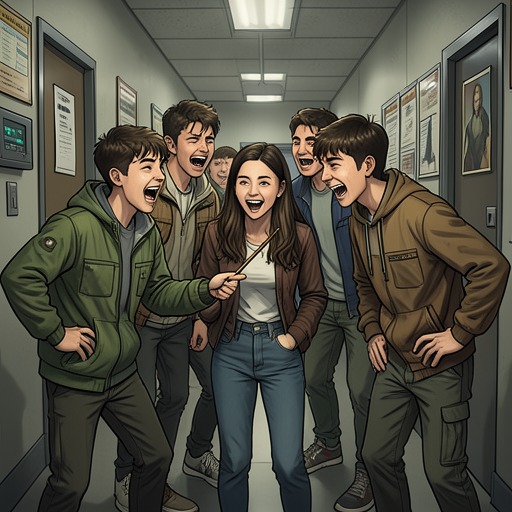
The school preserves a written trace of Carrie’s status among her peers: graffiti scratched on a desk reads, "Roses are red, violets are blue, sugar is sweet, but Carrie White eats skit." The childish rhyme turns Carrie into a public object of disgust, reducing a person to a recurring joke that can be left behind in the school’s furniture. This early insult matters because the harassment did not begin with the later shower-room incident; Carrie remembered that the laughter had started when she first entered Barker Street Grammar School and continued through the years.
The school’s role in that history is therefore part of a longer chain of social ostracism rather than an isolated episode. Susan Snell later acknowledged that the girls’ mean tricks had been continuing since grammar school and had become so habitual that she could no longer remember where they began. Her account distinguishes the persistence of the girls’ cruelty from the shorter teasing practiced by boys: the girls’ ridicule went on, accumulated, and helped make public appearance itself unbearable for Carrie.
Christine Hargensen’s Disciplinary Record
Chamberlain Junior High School also appears in the record assembled against Christine Hargensen. Before her senior-year conflicts with school authorities, she had already received a suspension for putting a firecracker in another girl’s shoe. The prank nearly cost Irma Swope two toes, giving the incident a physical consequence far beyond ordinary school mischief. The record presents Christine’s conduct as part of an established pattern, not an isolated lapse.
That earlier suspension sits beside a much larger disciplinary history at Ewen High School: seventy-four assigned detentions, including twenty for harassing students regarded as misfits, and fifty-one skipped detentions. The contrast exposes the limits of institutional punishment. Christine’s record was extensive enough to demonstrate repeated aggression, yet her social position and her father’s influence helped preserve her access to graduation and Oberlin. Chamberlain Junior High School is consequently the first named stage in a progression through which cruelty becomes both normalized among students and incompletely restrained by authority.
From Local Record to Wider Disaster
The school’s significance expands retrospectively after the destruction of Chamberlain, Maine, in May 1979. Later accounts treat the disaster as one of the twentieth century’s defining mass-media events and debate the role played by Thomas Everett Ross, Carrie’s escort to the Ewen High School Spring Ball. In that larger reconstruction, the early school record becomes evidence of the conditions that preceded the catastrophe: Carrie had been marked and humiliated for years, while one of her persecutors had already demonstrated a willingness to injure another student.
The wider narrative also connects the school history to the debate over Carrie’s telekinetic ability. David R. Congress argues that such powers may remain hidden until extreme personal stress, while the case material describes a potential of immense magnitude within Carrie White. The institution did not recognize or address that danger; instead, the social pressures documented in and around its schools intensified until the later Spring Ball disaster converted private humiliation into public destruction.
Narrative and Thematic Significance
Chamberlain Junior High School functions as a site of origin and institutional memory. Its desk graffiti gives the persecution a durable physical inscription, while Christine’s suspension shows that the school system had already encountered dangerous behavior without transforming the surrounding culture. The location thus links two forms of failure: peers learn to treat cruelty as entertainment, and institutions record misconduct without preventing its recurrence.
Its retrospective force is especially strong because the final accounts insist that the Carrie White affair is over while immediately turning toward the future and the possible isolation of the TK gene. Chamberlain Junior High School belongs to the buried past of that argument, but it remains essential to understanding what the later catastrophe means. The disaster is not presented as emerging from nowhere; it grows from a history in which humiliation was repeated, archived, and allowed to become part of ordinary school life.